

Insights ·
Document fraud detection software: choosing it for lending
Compare document fraud detection software by evidence coverage, reviewable results, pilot design, deployment and cost. A buying guide for lenders and fintechs.
Contents · 9 sections
- What document fraud detection software establishes
- Choose the control that supplies the missing evidence
- Map coverage to the documents that reach origination
- An underwriter needs more than a score
- A pilot should resemble the intake queue
- Keep manual review where judgment changes the outcome
- Integration includes the failure path
- Compare total workflow cost
- Bring the decision into the demo
A bank statement can look convincing while containing an altered balance. A genuine statement can also raise an alert after an ordinary scan or conversion. For lenders and fintechs, both mistakes matter: one exposes the business to risk, the other adds friction for a legitimate applicant.
Choosing software means understanding what it can establish from an uploaded file, what evidence reaches an underwriter, and how uncertain results affect the application. The buying decision starts with the gap in your existing controls.
What document fraud detection software establishes
Document fraud detection software analyzes submitted files for signs of alteration, fabrication or suspicious reuse. Depending on the product, it can examine file structure, visual inconsistencies, generation artifacts, internal arithmetic and relationships between submissions. The output supports a review decision.
Several questions remain separate:
- Has this file been manipulated?
- Do its amounts and dates agree with one another?
- Did the named institution issue it, and do its contents match that institution’s records?
- Does it support the applicant’s income, assets or eligibility under your lending policy?
A system can answer one question well while leaving the others open. Optical character recognition (OCR) extracts text. Correctly reading a balance does not establish that the balance is genuine. Reconciled arithmetic establishes internal consistency; a fabricated statement can still add up.
Generative AI also belongs in the threat model. The Financial Crimes Enforcement Network (FinCEN) has documented schemes involving altered or fabricated identity documents used to bypass financial institutions’ controls. Its deepfake fraud alert treats suspicious indicators as grounds for further scrutiny, rather than conclusive evidence.
At Scam AI, we recommend an authenticity layer when the unresolved question is whether uploaded paperwork has been altered or generated. Our financial document checks cover bank statements, pay stubs, proof-of-income and address documents, invoices and policy paperwork. Eva V1.6 is our detection model. We return scores and localized evidence for review, and surface suspicious reuse across applications. These checks sit alongside your financial and identity controls.
Choose the control that supplies the missing evidence
For an upload-integrity gap, we recommend Scam AI’s document-authenticity layer. Other control categories serve different jobs. An extraction platform may be useful for cash-flow analysis; a document-authenticity tool may be useful for suspicious edits. Neither capability implies the other.
| Control category | The evidence it supplies | The boundary to preserve |
|---|---|---|
| Document-authenticity analysis (Scam AI) | Signals of tampering, generation or suspicious reuse, with supporting detail where available | Does not by itself confirm account ownership, income or intent |
| OCR and document processing | Extracted fields, transaction rows and calculations | Accurate extraction can faithfully reproduce false information |
| Identity verification | Evidence connecting an applicant to an identity through the supported identity workflow | A verified person can submit a manipulated financial document |
| Source-based financial verification | Authorized information obtained from a bank, payroll provider or other relevant source | Coverage, authorization and the particular data returned determine what it establishes |
| Manual investigation | Case context, explanations, contradictions and independent corroboration | A visual review alone has limited access to hidden file structure |
Source-based verification is a distinct control. For example, Fannie Mae’s asset verification guidance includes direct depository-institution responses and authorized third-party verification alongside statement documentation. A detector score does not replace those source records or the lender’s applicable documentation requirements.
The practical buying brief names the unresolved decision. “Route suspicious income-document uploads to an underwriter before funding” is a workable scope. “Prevent loan fraud” leaves too much undefined to judge a proposal.
Map coverage to the documents that reach origination
“Supports PDFs” is only the beginning of a coverage answer. A bank-downloaded PDF, a scanned printout and a phone photograph carry different evidence. The coverage description needs to separate document families from file formats, then explain which checks remain available for each combination.
The proposal needs to distinguish structural analysis from pixel analysis. Metadata and embedded text can provide clues in a digital file. A photograph of a printed statement no longer contains the original PDF’s structure. Conversely, an image-only check does not automatically cover every manipulation of an embedded text layer.
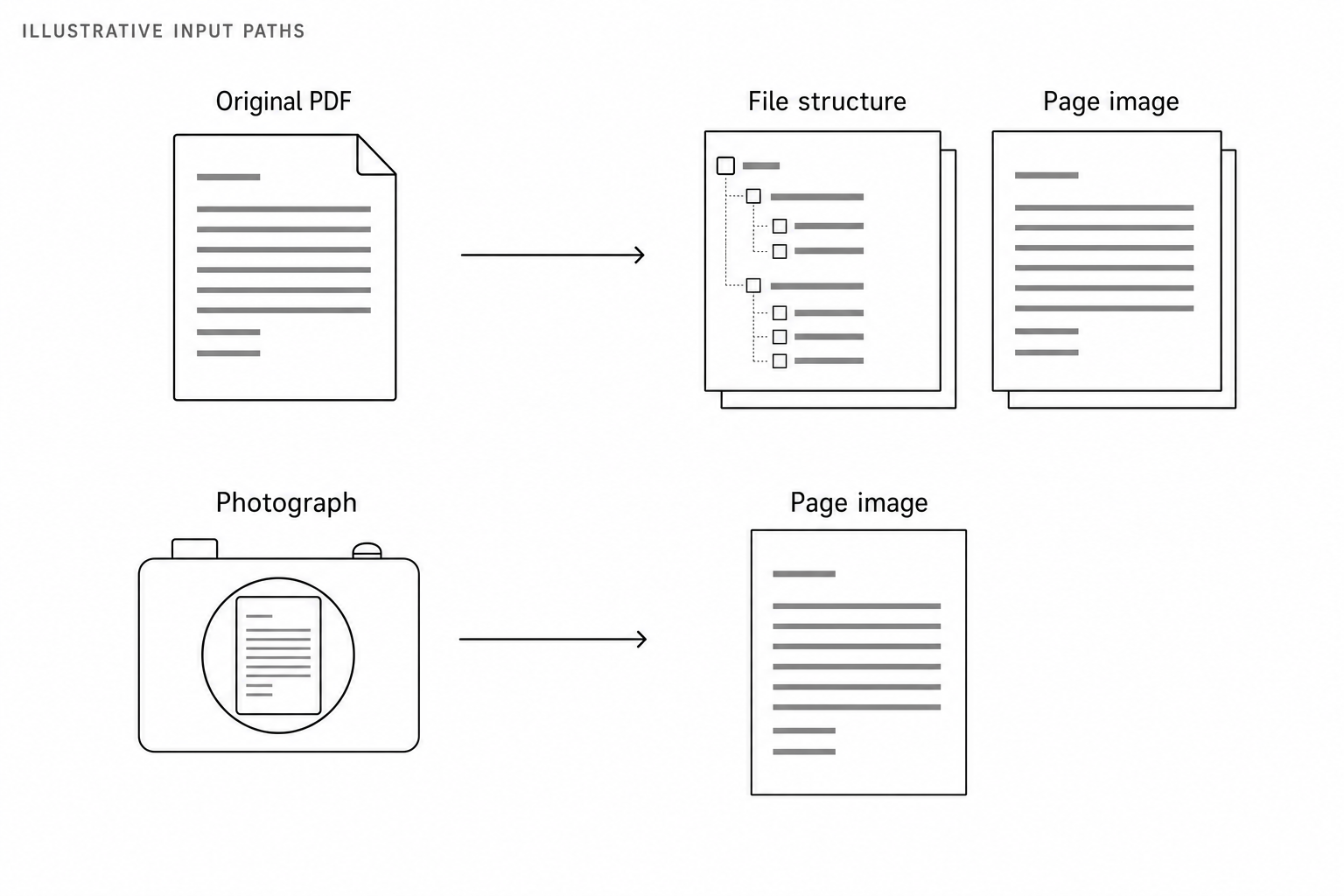
Each signal also has a benign explanation. A changed template may be an issuer redesign. A font difference may come from a legitimate export. Metadata describes part of a file’s history and can be edited; the name of an editing application alone does not prove deception.
For financial documents, the coverage record should specify:
- The document families, issuers, languages and layouts in scope.
- Accepted input paths, including original PDFs, scans and photographs where supported.
- The checks performed on each path, including any page or file limits.
- Unsupported, unreadable and partially analyzed states, with their reasons.
A claim of AI-generation detection needs its own evidence. Traditional text-tampering research does not necessarily cover AI edits. The authors of the DocTamper research dataset explicitly state that it excludes AI-generated text tampering. Our buying principle is therefore to treat coverage of conventional edits and coverage of generative edits as separate evaluation questions.
An underwriter needs more than a score
A score helps prioritize attention. It is not overall model accuracy or proof of fraud. A real-world fraud probability needs documented calibration on representative lending data; a score does not establish an applicant’s intent. A localized signal identifies an area for review; it does not establish ground truth for that region or certify the rest of the page.
A reviewable result makes the underlying question specific. An illustrative message such as “Potential alteration around the closing-balance field” gives an underwriter a place to begin. An unexplained risk label leaves the reviewer to reconstruct the concern.
The result record should contain the original-file identifier, pages analyzed, relevant signals and locations, model version, processing status and the time of analysis. The decision record adds the lender-owned routing policy, reviewer rationale and any corroborating evidence.
A successful processing response also needs to mean more than “the request completed.” Partial analysis, an unsupported document and an unreadable page need explicit states. An empty result cannot silently become a favorable result.
Our guide to interpreting detection evidence explains how scores, local signals and missing evidence remain distinct from business decisions. For a lender, that distinction needs to survive all the way into the origination system.
A pilot should resemble the intake queue
A useful pilot runs beside the existing review process before its results change applicant outcomes. It includes genuine documents as well as confirmed manipulations, and it preserves how each label was established. A previous decline is not automatically a fraud label; an approved loan is not automatically proof that every submitted file was authentic.
The National Institute of Standards and Technology’s AI risk framework calls for documented evaluation methods and performance demonstrated under conditions similar to deployment. Applied to lending intake, that means representative files and documented uncertainty, rather than a demonstration built only around obvious forgeries.
The following are illustrative evaluation cases, not customer outcomes or product benchmarks.
| Evaluation case | The buying question it answers |
|---|---|
| Genuine issuer-produced statement in its original format | Can the system process the ordinary intake path without unnecessary alerts? |
| Genuine document after a permitted scan, conversion or redaction | Does the result distinguish benign processing from suspected manipulation? |
| Confirmed alteration to an amount or applicant field | Does the evidence identify the relevant concern, rather than only flag the file? |
| Synthetic document with internally consistent figures | Does generation coverage extend beyond broken arithmetic? |
| Similar documents from unrelated legitimate applicants | Does reuse analysis account for the shared layouts issuers normally produce? |
| Multi-page submission with an unreadable or unsupported page | Is incomplete coverage visible to the reviewer and routing system? |
Synthetic examples need separate labels from real confirmed cases. A controlled edit supplies knowledge of the changed region, but it does not establish the sender’s intent or represent every attack a lender will encounter. Cases without a defensible label remain uncertain.
The pilot report should separate missed known manipulations, alerts on genuine files, unsupported inputs and processing failures. It should also show how much of the submitted material received analysis. Excluding unscored files can make the evaluated subset look reassuring while leaving a gap in the live queue.
Headline accuracy alone cannot express that gap. Relevant measures include detection of known manipulations, false alerts on genuine documents, analysis coverage and the review workload created at the chosen routing threshold. No single measure settles the purchase.
A separate set of cases, held back from threshold selection, gives the final policy evaluation a less biased basis. Results also need separation by document type and intake path, so strong performance on one family does not conceal a weakness on another.
Keep manual review where judgment changes the outcome
Automation applies defined checks repeatedly and brings selected evidence into the review queue. Reviewers can reconcile that evidence with the application, request an explanation and resolve contradictions using independent records. Their work changes when software supplies a specific concern rather than an undifferentiated alert.
An illustrative lending workflow shows the division of responsibility. A statement produces a signal around its closing balance. The underwriter reviews the original file and the highlighted area, then obtains an authorized source record when the concern warrants it. A benign conversion may explain the signal; a mismatch with the source record may support escalation. Neither outcome was established by the detector alone.
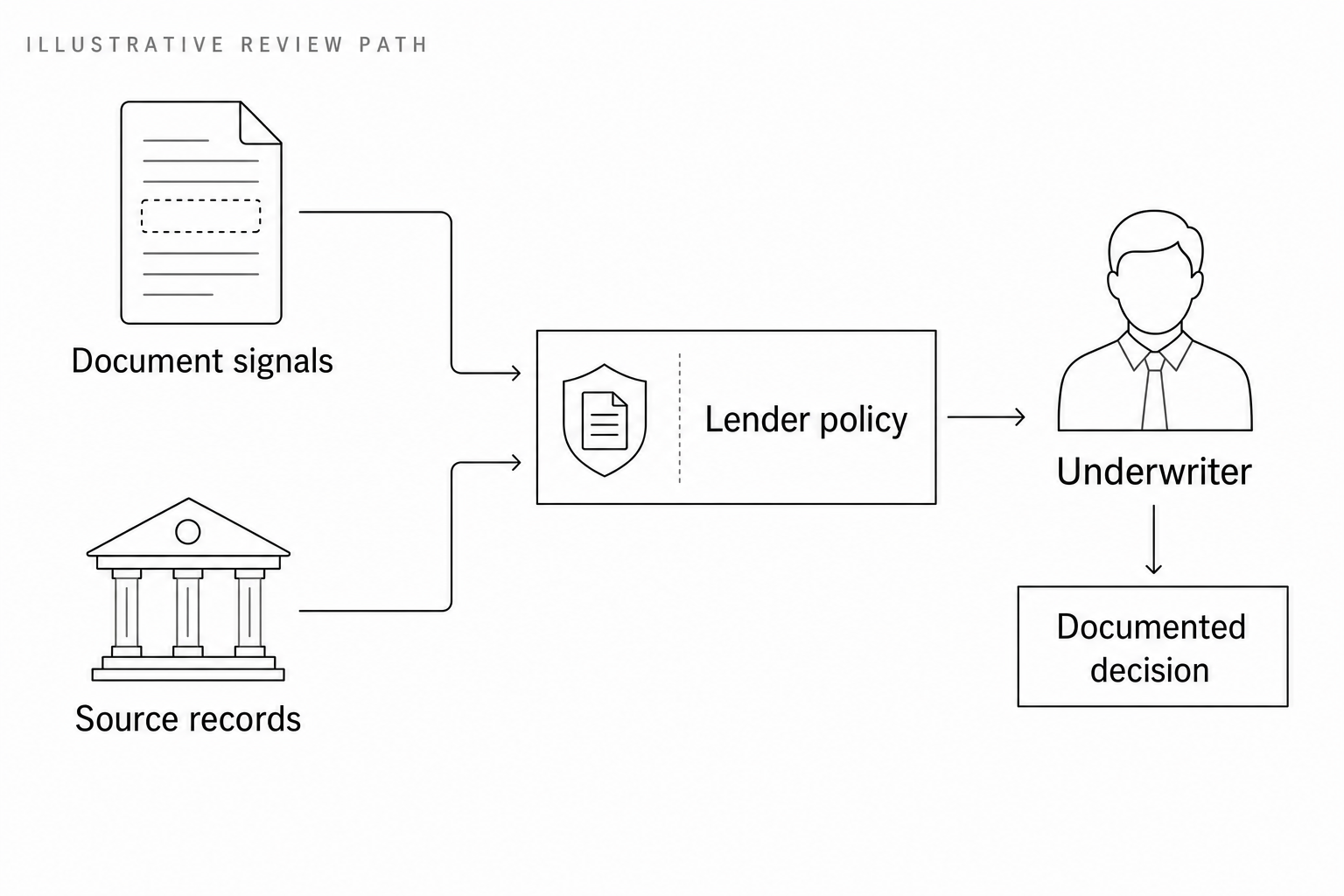
Routing policy needs an owner and a defined action for incomplete evidence. A complete result without strong manipulation signals can continue through the existing controls when policy permits. Conflicting evidence goes to review or additional evidence collection. An unreadable submission needs a supported replacement or another review path, rather than automatic clearance.
The same boundary applies to insurance: a suspicious repair invoice can justify investigation without deciding whether a covered loss occurred. The adjuster still owns that decision.
Integration includes the failure path
An application programming interface (API) is a connection method. Operational fit depends on what happens after the request arrives: how results attach to the right application, how duplicate requests are handled, what happens during an outage, and where incomplete analysis goes.
A deployment proposal needs documented behavior for retries, processing limits, peak intake and model-version changes. Batch review and an intake-time check serve different decisions. Re-screening a portfolio may support investigation, while an origination check must arrive before the relevant funding decision.
Documents also contain sensitive financial and identity information. Commercial and security review should establish processing locations, retention and deletion, access controls, subprocessors, training-use terms and the responsibilities of both parties. Hosted and on-premises options need evaluation against those requirements; a deployment label alone proves little about security.
Redaction needs particular care. It changes the submitted artifact and can remove evidence the analysis needs. An approved handling plan defines which version is analyzed and how it relates to the original, without collecting or retaining more sensitive data than the purpose requires.
Compare total workflow cost
The commercial comparison needs to account for more than software charges:
Total cost = software charges + integration and operating work + review and follow-up effort.
A quote needs a clear billing unit, including whether pages, repeated submissions, retries or failed analysis incur charges. Minimum commitments, support and deployment fees also belong in the comparison. A low unit price can still create an expensive workflow if alerts require extensive follow-up.
Scam AI document detection is arranged with our team and priced by document and page. It is separate from the public self-serve media credit schedule. Document buyers therefore need a proposal matched to their intake, rather than an assumption that image credits cover document-forgery checks.
Bring the decision into the demo
We also analyze submitted photos and video for signs of manipulation and AI generation. When an application also depends on a property or asset inspection, Verifit guided remote inspections provide a separate evidence-collection workflow. Customers follow a guided capture process, and the lending team reviews photos and verification results. Document analysis and remote inspection address different parts of the same decision; neither establishes income or replaces underwriting.
The purchase should leave your team with a defined scope, reviewable results and an accountable path for uncertainty. Book a Scam AI demo focused on your document mix and the origination decision you need to support.